
702-569-2849
24/7 Las Vegas Pest Control Emergency Service
702-569-2849
24/7 Las Vegas Pest Control Emergency Service
Hot weather doesn't keep pests out of a house. If anything, it pushes them toward whatever your property offers: shade, a little moisture, food scraps, or a gap under the garage door. Enviro Guard builds every plan around what actually turns up during the walk-through, not a generic checklist somebody printed off years ago.
Schedule Your Free InspectionFast. Easy. No Obligation
A”My house is clean; why do I have bugs?” Our techs hear that on almost every call. A scorpion looking for shade doesn’t care how clean your kitchen counters are, and neither does an ant colony that found a crumb trail three weeks ago.
Garages, block walls, irrigated yards, patios, attics, kitchens, and storage rooms—that’s where most of the activity turns up. Sometimes it’s obvious the day you look. Other times it’s a hairline crack near a utility line that’s been open for years, and nobody noticed.
A scorpion by the garage and ants on the kitchen counter aren’t the same job, not even close. One’s usually an exterior structural issue. The other tends to be a food and moisture trail coming in from outside.
That’s why the whole property gets a look, not just the one spot you pointed to. Where’s the activity actually coming from? What let it in? What kept it fed this long? Those get answered before treatment ever comes up.
Enviro Guard has worked in Las Vegas since 2006. Honestly, it’s the same handful of problems over and over across the valley, just wearing a different house each time.
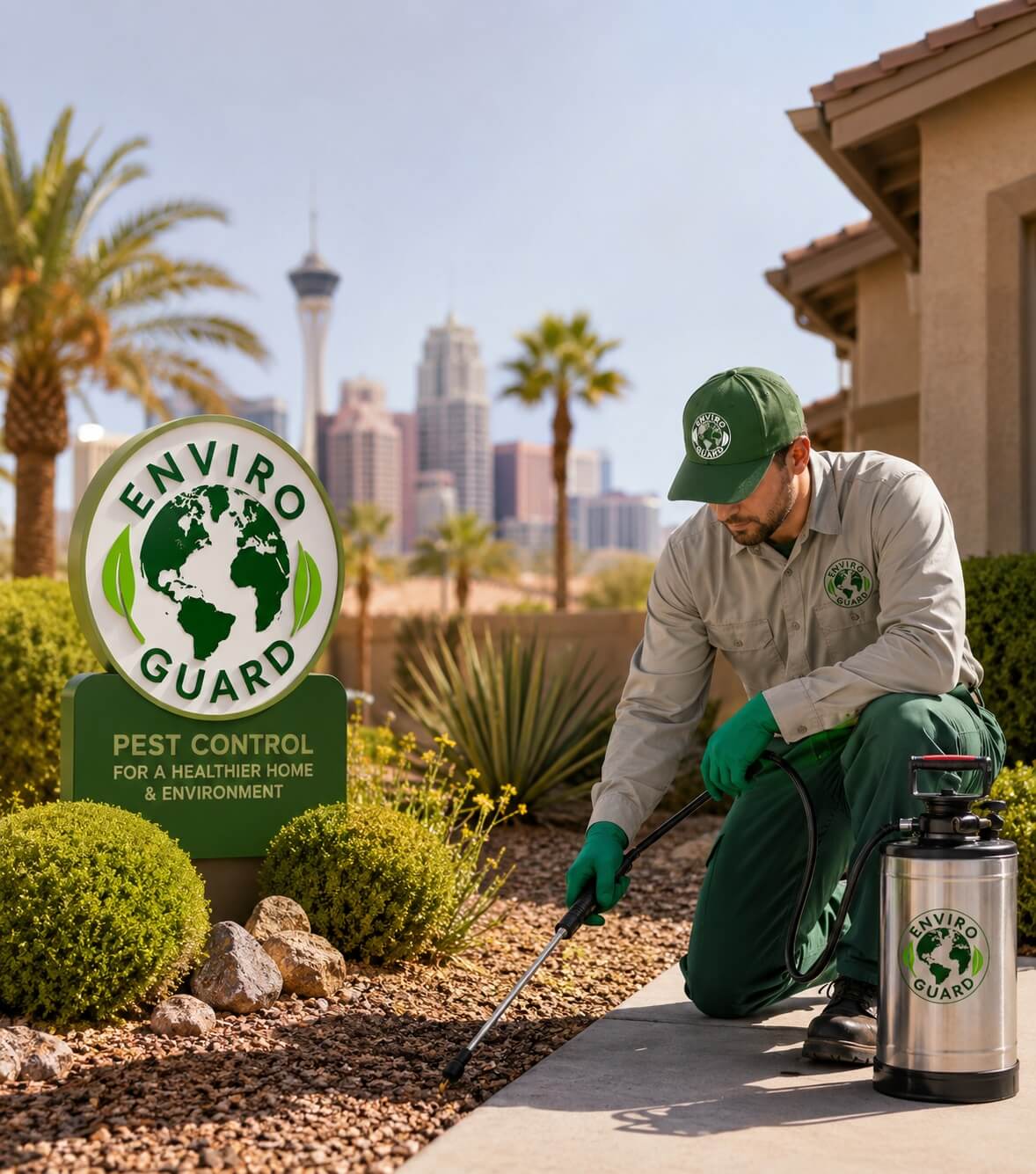
Two houses on the same street can end up needing two completely different plans.
A visit usually covers:
Take an ant trail. It might run straight from a sprinkler line into the kitchen. A scorpion sighting tells a different story most of the time: a gap in the garage, a stack of firewood, or a block wall with hollow cores nobody’s checked in a decade.
Treating the spot where you saw the bug isn’t really the point. Figuring out why that spot appealed to it in the first place is.
Not sure what’s going on at your place? A free pest inspection in Las Vegas is the easiest way to find out for sure.
Every property’s a little different depending on landscaping, moisture, and what’s next door.

Follow an ant trail, and it’ll usually lead somewhere useful: an entry point, a nest, or a food source. That’s where our ant control work starts.

Cockroaches show up around kitchens, plumbing lines, appliances, and cabinets. Warm, damp, hidden spots are exactly what they’re after, which is where cockroach control usually starts.

Spiders build webs around garages, eaves, exterior walls, and corners, anywhere insects gather for them to eat. Spider control in Las Vegas starts by checking those activity areas.

Scorpions hide in garages, block walls, landscaping beds, and door thresholds, anywhere sheltered outside. Las Vegas scorpion control starts by checking those areas and nearby entry points.

Bed bugs turn up in mattress seams, bed frames, and furniture cracks, basically anywhere near where someone sleeps. Bed bug removal starts by finding those hiding places.

Silverfish prefer dark, damp areas such as bathrooms, storage spaces, cabinets, and wall voids. Silverfish control focuses on where they’re hiding and the moisture conditions keeping them around.

Crickets often gather around exterior lights, landscaping, garages, and other sheltered areas before finding a way inside. Cricket control starts with those activity spots and nearby entry points.

Earwigs tend to stay in damp, sheltered areas around landscaping, patios, mulch, and other places with moisture. Earwig control looks at those conditions and how they’re getting indoors.
Bees build nests around rooflines, patios, eaves, wall voids, and other protected areas. Bee control starts by locating the nest and checking how close it is to the home.

Standing water, irrigation runoff, shaded planters, and poorly circulating pools give mosquitoes places to breed. Mosquito control starts with finding those water sources around the property.

Pigeons settle on roofs, ledges, patios, and covered walkways. Nesting and droppings pile up fast once birds move in, which is where pigeon control picks up.
A tidy house isn’t the same thing as a pest-proof house. Big difference.
Pests need four things to stick around: food, water, shelter, and a way in. Here’s roughly where those come from.
The guide to Las Vegas pests and the conditions that attract them covers this in more depth if you want it.
A full-blown infestation isn’t the bar for calling someone. Not even close.
Worth paying attention to:
One bug on the counter doesn’t mean much by itself. Ten in a week does.
Kitchens, garages, attics, patios, landscaping, and foundations all get checked for live activity, droppings, webs, damage, moisture, and any opening a pest could use.
The exact pest and where it’s concentrated get pinned down, along with the entry point and whatever’s been keeping it fed on the property.
Treatment depends on the pest, the location, how bad things have gotten, and the conditions around the property. All of that gets walked through before anything starts.
Depending on the situation, that might mean targeted applications, baits, dusts, traps, or exclusion work. No two jobs really call for the same approach.
After treatment, activity gets checked to see if it’s actually dropping off. Recurring visits catch anything starting back up before it turns into a bigger problem again. Want more detail on this? Check the guide on what happens during a pest inspection.
The room where you saw the pest is only the starting point for a single-family home. Garages, yards, attics, foundations, and exterior walls all factor in too.
In an apartment or condo, shared walls and plumbing often matter more than your unit alone does. That’s especially true with ants, roaches, and bed bugs.
A reported problem at a rental property still needs a real look, not a guess. The property gets inspected, and the findings get explained plainly, with no vague language.
Even a new home a year old can have gaps in the framing or landscaping conditions that invite pests in. Worth checking rather than assuming a new build is sealed up tight.
It depends entirely on the pest and the property, honestly.
A one-time visit fits an isolated problem, like a single scorpion sighting with nothing else going on.
Recurring service makes more sense when landscaping, the surrounding desert, or ongoing conditions keep bringing pests back no matter what anyone does.
Preventive service isn’t just spraying on a timer and calling it done. It means checking activity, watching problem spots, and adjusting as conditions shift through the year.
For most homes, quarterly service is a reasonable baseline. Heavy scorpion, roach, or rodent activity might call for something tighter.

No set number applies across the board. Pricing shifts based on things like:
Free inspections and estimates mean the full picture is clear before committing to anything.
More detail is in the guide to Las Vegas pest control costs.
Treatment works better when the property’s pulling its weight too.
Check the usual gaps around doors, windows, pipes, utility lines, vents, and foundation seams.
Fix leaks and irrigation issues, and don’t let water sit anywhere for long.
Keep plants and mulch from touching the walls directly.
Clear out debris, stacked materials, and anything else creating a hiding spot close to the house.
Store pet food properly, wipe up spills, and keep trash cans shut tight.
Keep garages and storage areas organized enough that you’d actually notice if something moved in.
Enviro Guard has worked in Las Vegas since 2006, picking up the local pest patterns one house at a time.
Licensing runs through the Nevada Department of Agriculture under company license #6663. Primary principal Steve W. Langman holds Nevada license #200474.
Inspection comes before treatment, always. That’s not a slogan on a truck; it’s just how the job gets done right.
Where it makes sense, EPA 25(b) minimum-risk products get offered, with label directions followed closely every time.
Inspections and estimates are free, so there’s never any guessing at cost before the problem’s even been seen.
No long-term contracts either. What you need depends on your pest problem, not a plan somebody’s trying to lock you into.
Some things genuinely can’t wait until next week.
Call right away for:
Our 24-hour pest control service covers exactly this kind of thing. Call 702-569-2849 to check availability.
Service areas include:
Don’t see your area listed? Call 702-569-2849, and you’ll get a straight answer on whether it’s covered.
Not necessarily. One bug could be a fluke. But if it keeps happening, or droppings and nesting material show up too, it’s worth a look.
Yes, and usually it should. Depending on the pest, that can mean kitchens, garages, attics, yards, patios, and every entry point in between.
Varies by pest, honestly. Some activity drops off fast. Anything hiding deep in a wall or cabinet can take a bit longer to clear out fully.
Hold off if there’s an active problem going on. Trails, droppings, and nests actually help figure out what’s happening, so don’t scrub them away right before the visit.
That usually means something’s still feeding the problem: an entry point, moisture, food, or a spot on the property that never got treated. Worth another look rather than another can of spray.
Figuring this out alone isn’t necessary.
The property gets inspected, the findings get explained clearly, and the next step gets recommended based on the pest and the house itself, not a script off a clipboard.