One spider isn’t a problem. Spiders showing up again and again, webs that keep coming back after you clean them, egg sacs, spiders in more than one room. That’s different, and it usually means there’s a reason behind it.
Las Vegas gives spiders plenty to work with. Hot days push them toward cooler, sheltered spots. Block walls crack. Garages fill up with boxes nobody’s opened in years. Porch lights run all night and pull in the bugs spiders eat. None of this is random. Spiders go where there’s shelter and food, same as anything else trying to get by out here.
Here are seven signs it might be time to look at spider infestation control in Las Vegas, and what’s fine to handle yourself first.
7 Signs You May Need Professional Spider Control
Most sightings don’t mean much. But a few patterns show up right before people decide they’re done handling it themselves.
1 You’re Finding Spiders Over and Over Again
One spider in the garage that you have seen once doesn’t matter. What matters is if it is occurring once every few days rather than once every few weeks, or if the number is accumulating, or if it happens in the same spot again after you have cleaned.
A wolf spider crossing the garage floor at night is usually just hunting crickets or roaches passing through. Fine, that happens.
But the same kind of spider showing up in the same corner week after week means something’s keeping it there and worth a closer look. An entry point that never got sealed. A steady supply of food nearby. Sometimes both at once.
If you’ve cleaned up a couple of times and it hasn’t slowed down, it’s probably worth looking into how to get rid of spiders in Las Vegas instead of dealing with it one spider at a time.
2 You Keep Finding New Webs After Cleaning
Sweeping down a web takes ten seconds. The real question is why one shows up in that same spot three days later.
Garage corners, eaves, patio ceilings, window frames, doorways, storage boxes, gaps along block walls. Those are the usual spots.
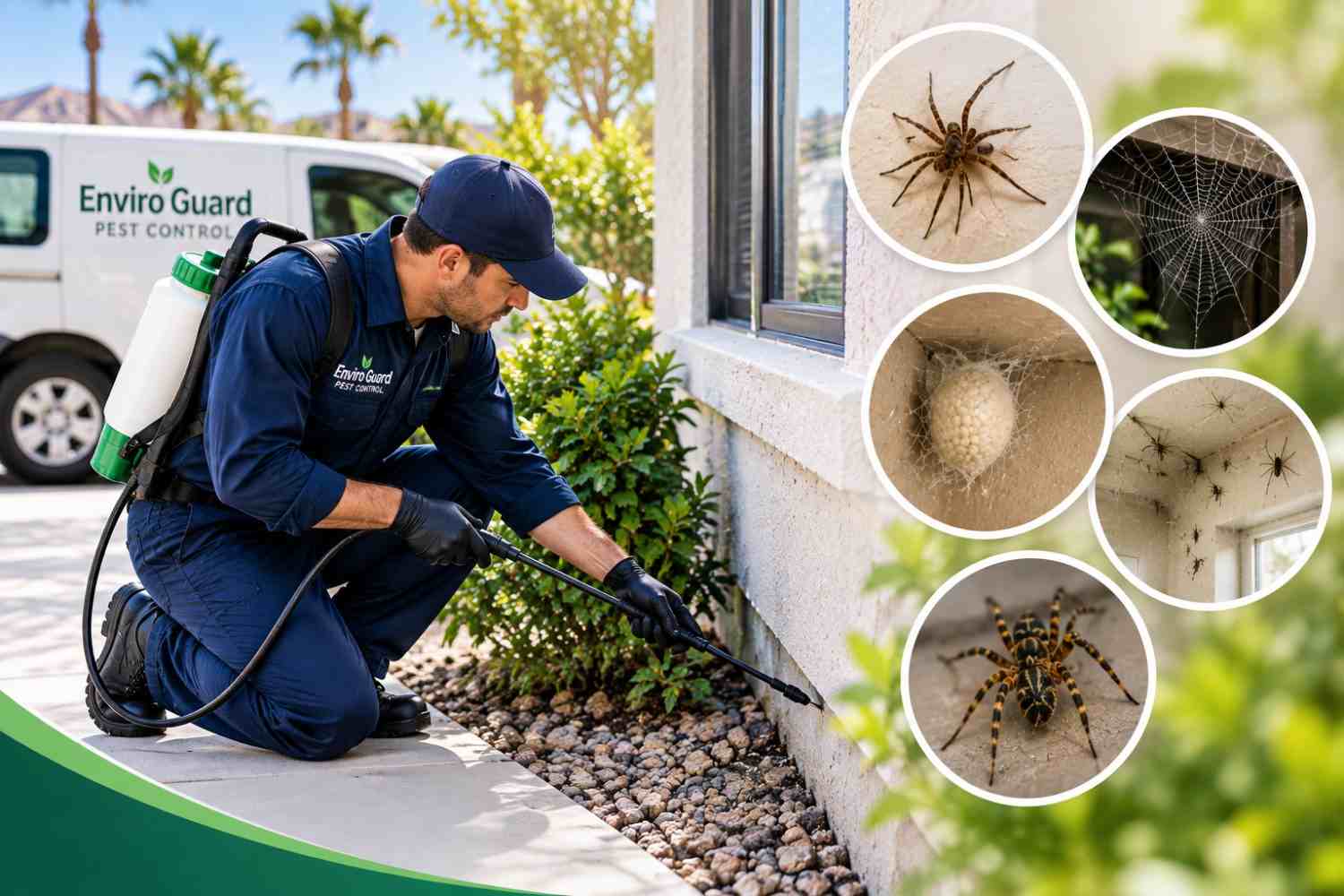
And not every web means the same thing. Common house spiders build messy webs in corners and pretty much stay put once they’ve settled in.
Cellar spiders spin loose, tangled webs in dark, quiet places like closets and garages and leave them alone for months. Wolf spiders don’t build webs at all, so if you’re seeing a spider moving fast with no web anywhere near it, that’s your answer.
Getting rid of a spider web is a good first step, but it doesn’t address the reason spiders are there. If insects are nearby, a gap gives them easy access, or if the area stays quiet, spiders may build another web. Repeated webs are a sign to check the area more closely.
3 You Find Spider Egg Sacs
Spider egg sacs look like small, round or oval silk pouches in off-white, cream, or tan. Their location may be attached to the web or inside a crack where they are protected. They can be in garages, storage shelves, under eaves, and behind boxes or other items that rarely move.
One sac isn’t a crisis. But it means more than a single sighting, because a spider doesn’t lay eggs somewhere it’s just passing through. It’s settled in.
How many spiderlings come out of a sac depends on the species, so don’t assume one sac means the garage is about to be overrun. What actually matters is finding more than one, or a new one after you’ve already removed one.
Identification matters too. What you do about a house spider’s egg sac isn’t what you’d do about a black widow’s. If you’re not sure which one you’re looking at, leave it alone.
4 Spiders Are Showing Up in Several Areas of Your Home
A spider in the garage is one thing. A spider in the garage, another in the bathroom, and a third in the closet is a different story.
Spread that wide, and there’s usually more than one way in, or enough food to support activity in several spots at once.
It’s the same reason pest professionals look at causes of pest infestations broadly instead of chasing one bug at a time. The same gaps and clutter that let a spider in tend to let other things in too.
Bedrooms, bathrooms, kitchens, garages, storage rooms, closets, patios, exterior doors: activity in any of these is worth watching.
In Las Vegas, common entry points are foundation cracks, gaps under doors, torn window screens, and weep holes in block walls. Cellar spiders and house spiders tend to settle in and stay. Wolf spiders are more likely to wander through than move in for good.
5 The Same Problem Keeps Coming Back After DIY Treatment
For minor issues, do-it-yourself spider control can be effective. Treat the locations where you notice spiders, remove any webs, and seal any gaps. However, if they continue to return a week or two later, the behavior is probably motivated by something more significant.
Usually it’s one of a few things: crickets or roaches still feeding them, an entry point that got missed, a web-building corner that never actually got disturbed, or a patio light left on all night pulling insects in.
Killing the spider you can see takes care of that one spider. It doesn’t answer why that spot keeps attracting them.
6 You’re Not Sure What Kind of Spider You’re Seeing
Most spiders around Las Vegas homes won’t hurt you. Wolf spiders, cellar spiders, and common house spiders make up most of what people run into, and none of it is dangerous.
Two are worth taking seriously. The western black widow lives throughout Southern Nevada: shiny black body, red hourglass underneath. Its venom is a neurotoxin, and the CDC notes it can cause real pain and other symptoms, though a bite is rarely fatal in a healthy adult.
The desert recluse gets mixed up with its more famous cousin, the brown recluse. Research in the Journal of Medical Entomology found the true brown recluse isn’t established in Nevada.
What people run into here is the desert recluse, which tends to stay outdoors in rock piles and woodpiles rather than move into houses. A brown or tan spider indoors isn’t automatically a recluse.
None of that is something you can sort out from a glance or a blurry photo. Don’t touch it, trap it, or crush it. A photo from a safe distance is usually enough for someone experienced to work with.
7 Spider Activity Is Affecting How You Use Your Home
Sometimes it’s not about counting spiders at all. It’s that you’ve stopped walking into the garage without checking first, or you skip the patio after dark now.
If spider activity has started changing how you actually use your own house, that’s reason enough to call someone, whether or not the spider count itself seems like much.

What a Professional Spider Control Inspection Can Tell You
When our technicians inspect a property, they look for the reason behind the spider activity. They check common hiding spots, webs, and egg sacs, then look for cracks, gaps, and other entry points that could be allowing spiders inside.
That includes spots DIY efforts tend to skip, like irrigation valve boxes and weep holes in block walls. It also means checking for insect activity that could be feeding the spiders, since the right approach for a house spider isn’t the right approach for a black widow.
That’s the approach Enviro Guard takes on spider calls in the Las Vegas area: inspect the property first, identify the species, and build a plan around what’s actually drawing spiders to that home. As a Green Business Certified pest control company, Enviro Guard also weighs environmental impact when deciding how and where to treat.
When You Can Try Spider Prevention Yourself
Start this if your problem is intermittent, and everything appears to be normal. Remove all the webs and eggs that you come across. Decrease the clutter inside your garage. Seal any openings around the windows and doors.
Turn off outdoor lights near entry points, since bugs love them and spiders follow. Clear brush and debris away from exterior walls.
That’s usually enough when the issue is minor. Bring in a professional when the activity keeps going despite all of that, spreads to new parts of the house, or involves a spider nobody in the house can confidently identify.
Quick Reference: What Your Spider Activity Might Mean
| What You’re Seeing | What It May Mean | What to Do |
| One occasional spider | Normal activity | Remove it safely and monitor the area |
| A few spiders over several weeks | Possible recurring activity | Check entry points and conditions around the property |
| New webs appearing repeatedly | Active spiders nearby | Inspect common web-building areas, such as garages and eaves |
| Spider egg sacs | Ongoing spider activity | Consider a professional inspection |
| Spiders in multiple rooms | Wider activity or possible entry points | Look for where spiders may be getting inside |
| Spiders returning after DIY treatment | Underlying conditions may still be present | Consider professional spider control |
| A black widow, desert recluse, or unknown spider | Identification is needed | Avoid direct contact and seek professional help |